
A Journey to the Sea: Business, Politics, and Culture in the Sea of Asia
Peng Song, Partner at Midas Capital, focuses on research and investments in the consumer industry and Chinese brands going global.
Half of Asia is mainland, the other half is ocean.
Indian coral tree1292
Two words were written on the wall. "The harbor of Tinbergen is one of the largest ports in the world, arguably the largest in the world," says a Moroccan named Bataille, one of the four medieval travelers. The other sentence is,“The port of Santong is here in the city... I dare say that there were more than a hundred ships carrying pepper from Alexander or other ports to Christian countries, so that Khan levied a huge tax on this port.”This is from the famous traveler Marco Polo.
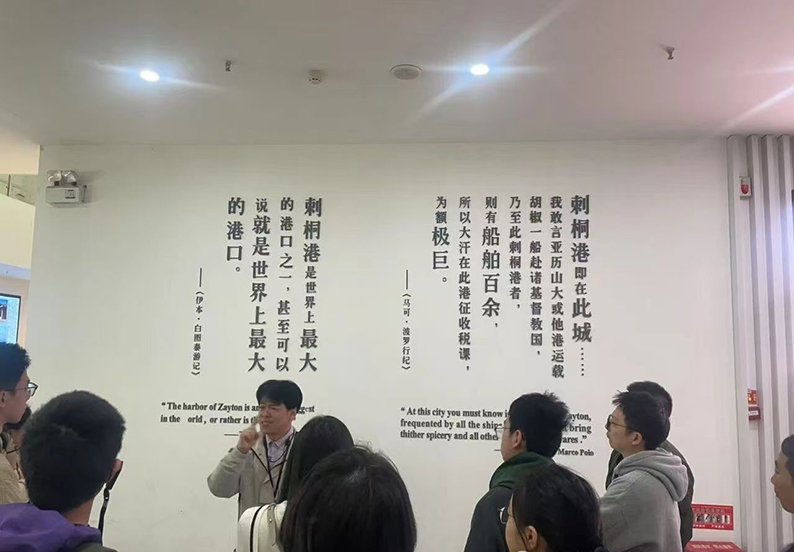
During the Spring Festival, my family and I visited the Quanzhou Overseas Transportation History Museum and read these two quotations on the wall of the entrance. The rulers of Quanzhou in the late Tang and Five Dynasties introduced erythrina trees to plant in the city, and later there was a city alias, erythrina. During the Song and Yuan Dynasties, Quanzhou was an important city for world maritime trade and the starting point of the Maritime Silk Road.The name ZAYTON (Erythrina) is well known overseas, especially in the Arabian world.
"Half-City Fireworks Half-City Fairy," which is the appropriate summary of Quanzhou poem. In the downtown area of Quanzhou, there are temples densely covered with major religions, such as Islamic mosques, Buddhist temples, Christian churches, Confucian Temple, Temple of Guan Yu and Mazu Temple. Each of them has its own audience. They are not far away from each other and live in peace with each other. It is also the cultural mark of Zitong City connecting home and abroad and attracting businessmen to make common fortune. South and north of Jiantong's coastline, there are also large ports such as Guangzhou, Mingzhou (Ningbo), which are prosperous in marine commerce, but they are not as open and inclusive as Jiantong, attracting a large number of overseas merchants to set up permanent residence here.
In the Song Dynasty, the department of "foreign trade" was established to supervise overseas trade. The office was located in Guangzhou. In the second half of the 11th century, because of the booming sea trade in Quanzhou, the branch of Quanzhou Shibo Company was added to facilitate the access of overseas merchant ships. Perhaps far from the political center, the area has tended to be more of a semi-autonomous trading city, with merchants ensuring a tax contribution, with studies suggesting that, at the end of the Southern Song Dynasty in the 13th century, Yantong City's tax revenue accounted for about 2% of the imperial revenue.
The latest paper, published in 2025 by Yale University's Cheng Zhiwu's team, "Maritime Trade and the Rise of China's South," even suggests that maritime trade, especially the porcelain trade, which was triggered and dominated by Arab-Persian merchants, was an important reason for the rise of the South during the Tang, Song, and Yuan dynasties. Based on data such as population growth in the South, porcelain kiln sites and circulation stamps, the paper concluded that Porcelain from China was a long-cherished product throughout the Arab world (highly competitive in quality and aesthetics), and "this market-driven Smithian growth was an important reason for the rise of the South during the Tang, Song, and Yuan periods."
In 1276, the Yuan army approached the city of Citong. At that time, the most powerful figure in the city was Pu Shougeng, a descendant of Arab sea merchants. His family, Arab Muslims, had come to Quanzhou for business and had long been established. Pu Shougeng himself had risen through the ranks of businessmen to become the head of the Quanzhou Maritime Customs, and his family was said to have dominated Quanzhou's business community for thirty years. Pu Shougeng made the profit-driven decision of a businessman, rallying forces within the city and surrendering it to the Yuan army, thus averting major unrest. He was also considered a traitor by the Southern Song court. The Pu family continued to manage the Quanzhou Maritime Customs during the subsequent Yuan dynasty.
The change of dynasty did not bring about a major shock to the thornwood, so around 1292, When the well-informed traveler Marco Polo visited Santong, it was the prosperous port of the East, and Marco Polo mentioned in his travels that he set sail from here to accompany the Mongol princess to marry in Persia. Perhaps he was in the fleet, but Proton or Persian history records the princess's marriage but does not mention Marco Polo in the marriage records. He may have been an invisible emissary.
In ancient times, ocean traders travelled according to the direction of the seasonal wind. It is suitable for sailing southwest for only a few short months. Marco Polo set sail from Port Sandor in the same season as Marco Polo in 1292 (the Princess actually set sail in 1291), and there was actually another huge fleet. As the Sinologist Xue Aihua said in his famous book The Xanadu of Samarkand, the three types of people who crossed thousands of mountains and waters and risked their lives to return to the Tang were presumably merchants, envoys and monks, driven by interest, power and religion, respectively. In the Asian seas, these same three forces, more powerful than the monsoons, are driving the continents to the islands, the locals to the distant.
Shi Fei, a Chinese general who returned to the Yuan dynasty, led a huge fleet of ships with his Mongolian deputy general.Between 20,000 and 30,000 soldiers, or 5,000 soldiers), under the orders of the Yuan Emperor Kublai, made an expedition to Java from Sentong in late 1292. Shi Fei was an important senior Chinese general who returned to the Yuan dynasty. He was on the expedition. In addition to the enormous and uncontrollable power conquest desire of the Yuan emperor at the time, the repeated maritime trade of the past hundreds of years should have allowed him to have some confidence in the route of this expedition. The route took three months to Cham and Java. At that time, the new kingdom of Khoshari on Java was overthrown by rebels, and the king's son-in-law, Wa Chai, asked the Yuan for assistance, and after the Shipwrecks arrived on Java (related artifacts such as Yuan weapons were unearthed near the eastern Java city of Surabaya, It was confirmed that the Yuan army had arrived) and that he had defeated the rebels with Waichae, who established what would become the kingdom of Manorban. Then Wei Zha Ye also organized forces, a strike against the Shi Bi fleet to drive away, so Shi Bi fleet to clean up the remnants of the summer monsoon, opened a two or three months ship back to Quanzhou. Szif himself was severely disciplined, but was eventually reinstated.
I was surprised to read this history. Eight hundred years ago, the Chinese had organized such an ambitious cross-sea expedition. After the war of re-election, the defeated soldiers are going home again across oceans and storms with hope for the future, another unknown Odyssey of the East.
Hirokazu Shirakawa takes the lead
During the same holiday, I later went to Kyushu, Japan. There is an area in Fukuoka City, which is the heart of the former port city of Hakata, called Hakata Old City Street. Through the Millennium Gate of Boji, walk two minutes along the Chengtian Temple to the side hall of the Chengtian temple. It is indeed in a position of gold beyond gold, in the heart of the largest seaport city in Japan for hundreds of years, Becca.
On the sign at Chengtian temple, it is said that the temple was established with the donation of Xie Guoming, a businessman from Ningbo. There is also a tomb nearby of Xie Guoming, surrounded by narrow trees and known locally as the Great Nan Bodhi.In a foreign country, it is impressive to see Chinese names similar to the names of Chinese businessmen Xie = Nationals, who have had a huge influence in Thailand.
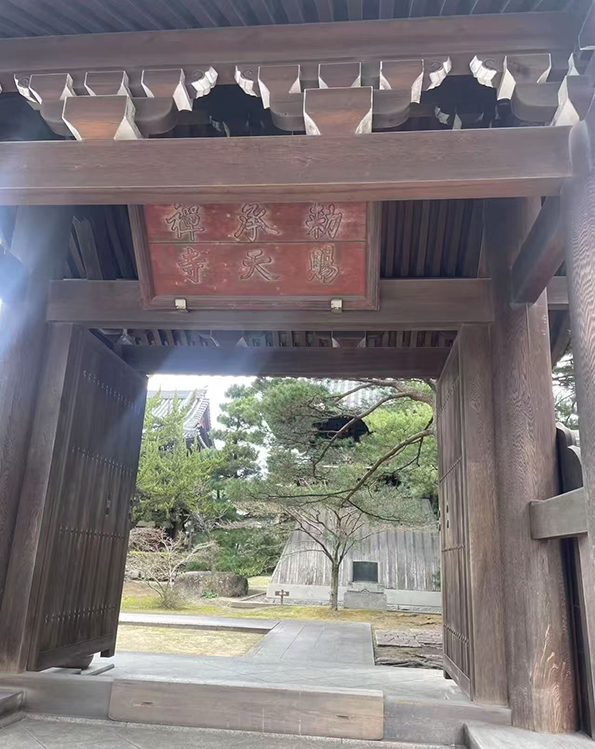
Bodo is located in the northwest of Kyushu, near the Korean peninsula, not far from Chinese Mainland. For hundreds of years around the millennium A.D., it was the center of the maritime trade between China and Japan. Since the Sui and Tang Dynasties, Japanese officials have dispatched envoys to China several times, and the exchange of religion, culture, technology, and commodities has become more extensive. After returning from China, the famous Master of the Air Sea landed in Hoba and founded Dongchang Temple here in 806, about two or three minutes from Chengtian Temple.
In the early stages of large-scale official exchanges between China and Japan, China set the framework for interactions with the Canton trade. That is, overseas countries donate gifts to express respect for the leadership of the Chinese imperial court, and the imperial court gives more gifts to let the envoys come home with happiness. The official trade in tributes between China and Japan occurred approximately once every fifteen years, with 838 being the last recorded thousand years ago, and was officially halted in 894 by the famous Japanese Crown Prince Michio Kannar. There are still a lot of ships going between China and Japan, but it is no longer an officially led trade in tributes, but a maritime trade driven by private commercial interests.
Japan established a hongnan palace in bodhisattva, under the leadership of the Taiji government, to manage ships and trade from overseas, and foreign merchants could only live and work in hongnan. Porcelain and silk from China are also very popular in Japan, and Japanese commodities such as sulfur and wood are also in great demand in China. Probably in the 11th century, the Hongnandian temple in Hoba suffered a major fire, and business was developed on a much larger scale, so Tangfang Chinese residential areas gradually formed in Hoba, and foreign Chinese merchants lived and integrated more deeply into Hoba life, which is also known as localization. According to different accounts, there may have been hundreds or even thousands of Chinese sea traders living there. One could think of Bado, which was open and far from the center of politics, as another pinion, another mirror image.
Japanese wood, compared with domestic Chinese wood, which continued to rise in price, presented a lower price and higher quality, and gradually became a popular product for shipments to China.In 1245 A.D., the director of the Jishan Temple in Lin'an, the capital of the Southern Song Dynasty, wrote to the director of Chengtian Temple, a newly built temple in Hokkaidō, and expressed gratitude to the director for his assistance in procuring a thousand large wooden boards in Japan.Runshan Temple suffered a fire in 1242 and is in the process of being rebuilt, continuing with high-quality timber, while Yuan Chin-yuan created the Toba Chengtian Temple in 1242 with the donation of Xie Guoming. In addition, from 1235 to 1241, Yuan Chin-Yuan studied Buddhism at Runshan Temple with the Unauthorized Teacher, only returning to Toba in 1241. In the letter, Mr. Qiang also mentioned that he would write a second letter specifically to Mr. Xie to express his thanks. The letter, written by Unauthorized Teacher, with the theme of "panado," is still preserved in the National Museum of Tokyo today.
Xie Gangshou is Xie Guoming, a Ningbo maritime merchant based in Batong. Gangfu, a recognized exclusive position of the city's cargo department in the Song Dynasty, referred to the chief of a fleet, usually as the shipowner and manager. Around 1232, Xie Guoming was already financially sufficient in Boji to provide some protection to monk Yuan Zhen Yuan, who was facing threats from other temples. Yuan Zhen Yuan stayed in Boji for three years before going to Chushan Monastery to study Zen Buddhism. After returning to Hobok to create the Chengtian Temple, Yuan Rishi became increasingly influential in Japan, and was later established by the Nino Dao, a leading member of the Diet in Kyoto, where he also lectured many times for the emperor and the shogun, and was eventually given the title of "Master of the Holy One."
Business is not an isolated business. In the process of localization, we must maintain a balance of interests, otherwise, hanging overseas, the interests are difficult to sustain. When he chose a change of dynasty in 1276, Pu Shougeng paid a promise to defect to the Yuan dynasty, while Xie Guoming found close partners in influential religious circles and donated to the Chengtian Temple in 1242. During the reign of the Yuan Dynasty, the Pu family ruled Quanzhou City. After the collapse of the Yuan Dynasty, the Pu family was depressed. Xie Guoming had been in Bodo for a short time, and the number of people was not prosperous. After the death of Xie Guoming in 1253, his Japanese widow tried to inherit the trading island he was running, but failed. The family business failed to continue, but Xie Guoming's story has become part of the local cultural tradition in Boji.
It can also be added that the huge EGO of the Yuan Emperor Bubilie was also projected on Hakata. In 1274 and 1281, the Yuan army attacked Japan twice.The first landed in Hokkai, but was beaten back by troops organized by the Kamakura shogunate. The second Yuan Army organized a larger force, but lost again in Hokkaidō. The typhoon is also said to be an important reason for the downfall of the Yuan Army. The Japanese called it "God Wind."
Sakai, Nagasaki and Batavia
One of the more famous ancient Japanese games, The Legend of Taguchi, tells the story of Hideki Funakoshi's rise under Hirohito Iwata. One of the tasks is for Hideki to buy a shipment of Japanese guns, which he must do in the merchant town of Sakai. Sakai was another important maritime trading city in Japan after Hakata, and was the original local manufacturer of guns and arms.
It is no secret that as a history lover who travels to sea, I also visited the Sakai Museum on my vacation. Taking a taxi from Osaka, the elderly driver, who seemed happy to talk to us, turned on his translator and asked, Are you going for a walk in the park? The sparsely visited Sakai City Museum is opposite the site of the largest emperor tomb left over from Japan's ancient tomb period. Both sides were deserted.Six hundred years ago, during the Warsaw Pact and Antoyama period, Sakai was probably the most prosperous port city in all of Japan, surpassing even Hakata.
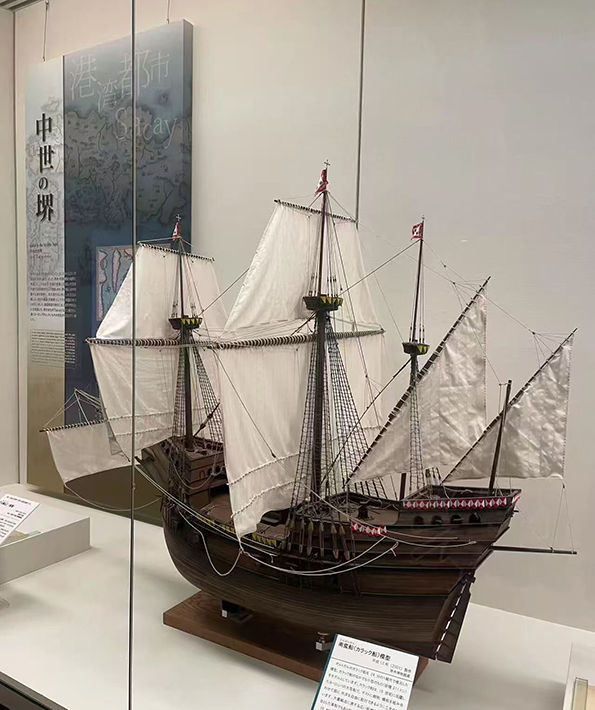
Political changes in Japan have driven the rise and fall of coastal ports. It was the Kamakura shogunate who led the army against the Yuan invasion in Toba, partly because the samurai fought a battle with the Yuan army, but the Kamakura Shogunate did not reward the prize. Among other political reasons, the rise of the Shikoku family, the fall of the Kamakura shogunate, the establishment of a new Sumitomo shogunate in Kyoto, which established an emperor, and another branch of the emperor's line to the southwest occupied Kyushu Island (where Beppu is), and Japan entered the North-South Dynasties. The Sumitomo shogunate certainly had its own controllable trading port connecting China to overseas, and the city of Sakai, near Kyoto, was a more suitable choice. Both rulers sent representatives to contact the Ming emperor. The southern representatives arrived first, but after a few decades, the Ming imperor realized that General Fu Li's side was more orthodox, and he mainly communicated with the Sakai city sent by General Fu Li.
Later in the Muromachi shogunate, Japan entered a wartime era of rising great powers, Sakai, Hakata, Nagasaki (not far from Hakata), Both became thriving maritime port cities, especially Sakai, because of the uniqueness of the region and the popularity of various cities. For several decades, Sakai became a semi-independent city governed by local merchants, similar to earlier European cities such as Venice, reaching the apex of urban prosperity. Of course, when Jiro Iwata takes over with his army of guns, he will not let Sakai City, a cash cow, go so far, and will soon bring Sakai City under his direct control. After Shinjiro Iwata and Hideki Funamori, Tokugawa really achieved the victory of unifying the whole world. Soon the Tokugawas put their rule on security first, and maritime trade was abandoned. In 1633, three generations of Tokugawa shogunate issued a series of closure orders to expel Christians, ultimately retaining only Nagasaki as a port for all of Japan's exchanges with the outside world. Sakai and Hokkai are naturally in decline.
Japan began locking up the country in 1633 until the "Black Ship Attack" in the 19th century was knocked open by US artillery. On the other side of the sea, Zhu Yuanzhang, Emperor of the Ming Dynasty, began to promulgate a ban on the sea in 1371, "prohibiting endangered people from going to sea privately," and only allowing tribute trade, and Japanese ships need to carry a "canaccord" entry. After that, the maritime ban was loosened and tightened, and the official Zheng He visited the sea several times, but the overall controls on civilian maritime trade were increasingly severe, and pirates failed to stop. The causes and consequences of the sea ban and the foreign invasion were also complicated because the fundamental needs for communication between China and Japan had not changed, such as the Ming Dynasty's need for Japanese silver and Japan's need of Ming copper.
Again quoting the concepts proposed in Professor Chen Zhiwu's team paper,"Market-driven, Smithian growth." As Japan's first sea trade city for hundreds of years, the economic development and the concentration of sea merchants have made it more likely that more complex and higher-order business forms will emerge. Take, for example, the rise of the Kobe Kamiya family and the exploitation of the Ishihara silver mine in Japan.The Ishii silver mine was the largest silver mine in Japan at the time, more than 300 kilometers from Hakata.Shibuya Shibuya, a wealthy businessman in Hakata, was optimistic about the opportunity for silver mining and wealthy, so he invested heavily and cooperated with local famous people to increase mining.Even more rarely, Shinji Shouzhen, which has a broad view, introduced the advanced technology of ash blowing from North Korea, and in one go, increased the smelting efficiency of the Shiseido silver mine by more than ten times. With high production and low cost, Ishihara silver became the most popular product of the Ming Dynasty, and records show that probably 80% of the silver produced in Japan went to the Ming Dmperor in the late 16th and first half of the 17th centuries, accounting for 30% to 50% of the Ming's annual silver use. Gensan, a descendant of Shiji Shouji's family, was also famous as a high-ranking tea-culturist and a national businessman, making repeated bets in favor of Shinjiro Iwata, Hideyoshi Funese and Kakugawa Tokugawa, always choosing the right side and the right time. Finally, Deichuan's family took over the whole world, and Zenya Zongzhan learned from Fan Zi and successfully retired.
After 1633, both Japan and China entered a state of maritime siege. Maritime trade will continue, but on a more tortuous model. In the seventeenth century, a new player arrived in the business and political arenas of the Asian Sea, the Europeans. If you look at the waters of Japan and Southeast Asia, the Dutch were the most active players, and their main body was the Dutch East India Company. The Dutch colonized most of Indonesia, and Batavia (now Jakarta) was the home of the Dutch East India Company. The Dutch attempted war with the Portuguese in Macau, tried but failed to take it, established bases in Taiwan but were driven out of Taiwan by the Chengs, and gained exclusive foreign trade opportunities in Nagasaki, the only open port in Japan.
During the Sino-Japanese maritime embargo, one trade route was that Dutch ships took Japanese silver and raw silk from Nagasaki to Batavia, while Chinese merchant ships went to Batavia to unload Chinese goods, load Japanese goods, and ship back. Controls and quotas in the name of national security distort transactions and prices, but demand remains, and even if the shipment reaches Batavia, it can be traded. Like so many Nvidia graphics cards sold in Malaysia. In the same way that hardware products that are affordable and quickly updated are estimated to be Chinese shareholders through to the end.
I also visited Jakarta several times last year, and it is said that the number of Chinese permanently resident here has increased in recent years. In the PIK area north of Jakarta, the proportion of Chinese and Chinese elements is very high, equivalent to a modern China city.
A History of Borneo
Batavia is on the northwest side of Java Island. To the north of Java is another large island, Kalimantan, formerly known as Borneo. Indonesia's new capital, Nusa Tenggara (which means the archipelago) is just southeast of Borneo. To the north of Borneo, there are two other countries, a small area rich in oil production, Brunei; The other is an eastern enclave of Malaysia. To the west of Borneo, there are two cities, one called Kuching, which now belongs to the Sarawak region of Malaysia; The other, called Kunming, belongs to Indonesian territory. Both cities used to have some gold mines, which attracted many Chinese to dig for gold, and corresponding Chinese groups also formed companies.
During the 1857 Lunar New Year, fierce fighting broke out in Sarawak, against a group of Chinese gold miners in the nearby Shillongmen area, believed to number probably 600, and against Riga (as the local chiefs called him) Brooke, a white Sarawak man at the time. At one point, gold company colleagues captured the official residence of Kuching, and Brooke managed to escape. Afterward, Brooke joined local tribes and armed British merchant ships to attack Shilongmen. The local Chinese mining community was bloodied, and many people fled the area.
It was a fight between two groups of guest residents. Brooke, a British businessman and friend of the Sultan of Brunei, was given jurisdiction over land in the Sarawak region. With the support of the British East India Company and some members of the navy, Brooke controlled the Sarawak region and taxed the Chinese gold miners there. Relevant historical records indicate that a Chinese group, mainly Hakka, gathered in the Shillongmen area near Gujing to dig gold, with thousands of people at its peak. After this battle, the Chinese community withdrew from the area, while the Brook family continued to rule Sarawak for nearly a hundred years.
In the Kundian region of Borneo, the Chinese gold-mining community established its roots earlier. Probably around 1777, the Hakka Lo Fangbo founded the Langfang Company there, Overall, it was comfortable with the local indigenous sultans and the Dutch neighbours, established legal, tax, military and other institutions, administered hundreds of thousands of Chinese and indigenous people, and developed an economy dominated by gold mining and pepper cultivation. At the beginning of his founding, Luo Fangbo sent his partners on a boat back to the Qing dynasty to claim power, hoping to gain legitimacy support. At that time, the Qianlong Emperor had little interest in overseas Chinese, and he called them "people of alienation," but he could not. The group remained autonomous for about a hundred years, until 1884, when the Dutch, after their growing power in Indonesia, invaded the area of Langone.
Postcript
The earliest writers of travel around the world might not have escaped one of these three identities, or both. Merchants, monks and envoys. Both The Tropics of Depression and Marco Polo's Travels are no exceptions. Modern transportation and advances in lifestyle have made travel a goal in itself, and a career as well. Continue to travel with a goal other than the trip itself and regain the beauty of the classical tradition.
Consumer brands venturing to the sea means no longer setting up re-export factories in a lonely region, but developing and promoting products to people in a particular region. Efforts need to be made to understand and connect, as well as to try to shape long-term stable patterns of interest. This makes the study of local culture and history not only a scholarly interest, but also potentially a commercial one. Just as American universities and research institutes received substantial funding to support Asian research after World War II, the country's elite saw it as politically and commercially valuable.
Asia is not only a continent, but also a sea. For thousands of years, people of all ethnic groups, including China, have traveled by boat to and from one another, building networks of business, power and faith. Looking back at the stories that have taken place in some regions in the past, chance and certainty are intertwined, with national security, government regulation, and open prosperity, technological progress.
Looking forward to future seafaring stories.
Referenced books:
"The Golden Peach of Samarkand," "The Net of Faith and Interest - Monks, Sea Merchants and Sino-Japanese Communication," "East India Company and the Sea of Asia," "Zitong City-the Place and World of China Along the Sea," "The Brock Dynasty," "The Times of Southeast Asian Trade," etc.
 3199 Flowers Rd S,Atlanta USA
 +1 678 568 1288
 wfoservice@hotmail.com